How to Plan Deaf‑Inclusive Campaigns: Community Outreach, Advocacy, and the CRPD in Practice
Community outreach, advocacy, and campaigning are often described as “inclusive,.” Many Deaf communities however least experience what inclusivity mean. A larger proportion of Deaf and Hard of Hearing individuals do not benefit from these outreach programs. While this gap is an unfortunate logistic, it is also a human‑rights problem rooted in how organisations design and deliver their communication.

A hand reaches out to another
Chapter 6 of Working With Deaf People: A Human‑Rights‑Based Guide for Inclusive Practice – “Community Outreach, Advocacy, and Campaigning” – tackles this problem head‑on. This blog introduces its core ideas for professionals, startups, and organisations that work with Deaf people and want their outreach and advocacy to be genuinely rights‑based.
Why outreach and advocacy are human‑rights issues
The Convention on the Rights of Persons with Disabilities (CRPD) is clear: access to information and participation in public life are rights, not optional extras. Article 21 requires states to provide information intended for the general public in accessible formats and technologies, including sign languages, in a timely way and without extra cost. It also requires authorities to accept and facilitate the use of sign languages and other forms of communication in official interactions.
Article 29 goes further, committing states to guarantee that persons with disabilities can effectively and fully participate in political and public life on an equal basis with others. That includes the right to vote and be elected, to take part in public affairs, and to form and join organisations of persons with disabilities. For Deaf communities, this presupposes access to information and public processes in national sign languages.
When outreach relies on radio, loudspeakers, spoken community meetings, or text‑heavy materials without sign‑language content or other accessible formats, it undermines these obligations. People cannot claim rights they never hear about, respond to consultations they cannot follow, or hold institutions accountable for decisions they never receive in an accessible form. Communication design becomes a core part of human‑rights implementation, not a technical detail.
From “inclusion on paper” to inclusive practice
Many organisations now reference inclusion and “leaving no one behind” in their strategies. Yet day‑to‑day practice often assumes hearing audiences, high literacy, and easy access to mainstream channels. A human‑rights‑based approach (HRBA) asks different questions:
Who is being left out of our communication, and why?
Which rights and obligations are engaged by this outreach or campaign?
How are Deaf communities involved as rights‑holders and leaders, not just as audiences?
The UN’s disability‑inclusive communication guidelines emphasize choosing media appropriate for target audiences, budgeting for accessibility, using multiple formats (sign language, captioning, easy‑to‑read, etc.), and regularly gathering feedback from persons with disabilities. Applying this to Deaf outreach means treating sign‑language content and interpretation as central design elements, not as last‑minute “add‑ons.”
In Chapter 6, this analysis is made concrete through examples: consultations that look successful on the surface but are inaccessible in practice, campaigns that rely on spoken media, and public meetings where Deaf participants are present but cannot follow proceedings. Each example is treated as a rights failure, not merely a communication glitch.
Centring Deaf leadership and using interpreters well
A core principle in Chapter 6 is simple: campaigns about Deaf rights are stronger when Deaf people lead them. Deaf leaders bring lived experience, contextual knowledge, and community credibility that cannot be substituted by hearing allies. Article 29 explicitly recognises the right of persons with disabilities to participate in political and public life, form organisations, and influence public affairs. Treating Deaf organisations as optional “stakeholders” instead of central actors runs against that logic.
For organizations and startups, this means:
mapping Deaf leadership structures (national associations, local clubs, Deaf women’s and youth groups, parent–Deaf alliances)
identifying informal leaders (Deaf educators, organisers, professionals) at local level
designing shared leadership arrangements – co‑chairs, joint steering committees, and shared decision‑making rules – so Deaf organisations are not relegated to symbolic roles
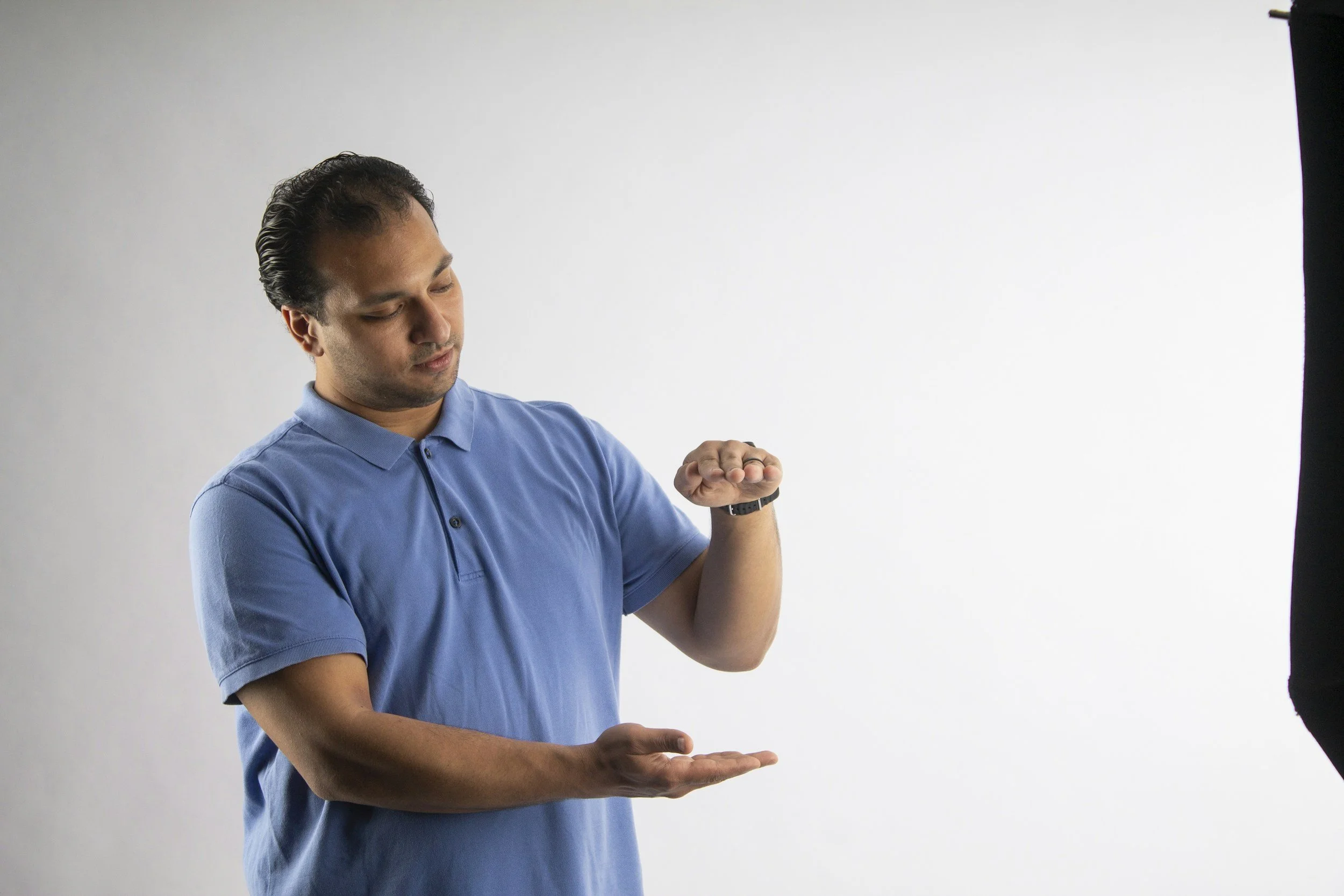
A male Sign Language Interpreter (SLI) in a blue polo shirt using open-palm classifiers to show the shape and size of an item.
Interpreters sit alongside this leadership, but with distinct roles. The guidelines stress that interpreters are communication professionals, not spokespeople. They need advance briefing, clear role boundaries, good logistics (sightlines, lighting, breaks), and strong confidentiality safeguards, especially for sensitive topics such as discrimination, violence, or political participation. When used well, interpretation enables Deaf leaders to take the microphone, address institutions, and negotiate change; when used poorly, it can mask the absence of Deaf voices in decision‑making.
For tech‑driven startups and digital platforms, the same principles apply. Automated captioning, sign‑language content, and accessible interface design can widen participation, but only when Deaf users and organisations are involved in defining requirements and testing products.
Designing inclusive campaigns: issues, audiences, and rights
Chapter 6 walks readers through designing campaigns that Deaf communities can access, shape, and own. It starts with the issue itself: vague complaints like “the system ignores Deaf people” are unpacked into concrete problems such as courts without sign‑language interpretation, emergency messages without accessible formats, or voter education delivered only via speech and print.
Each issue is then linked back to the CRPD:
Article 21 – for access to public information in accessible formats, including sign languages and captioning.
Article 29 – for participation in elections, public consultations, and broader public life.
This rights basis strengthens advocacy messages by connecting moral arguments (“this is unfair”) with legal obligations (“this breaches recognised duties”). Tools such as rights‑based messaging worksheets help teams define the problem, name the right, identify the duty‑bearer, specify the action requested, and clarify the expected outcome.
Campaign design then moves through:
audience and channel choices (Deaf communities, general public, decision‑makers)
accessible materials (sign‑language videos, captioned content, plain‑language text, clear layouts)
timing and sequencing (parliamentary calendars, elections, school terms, awareness days)
risk assessment (backlash, harassment, burnout) and mitigation strategies
Throughout, the chapter emphasises that last‑minute invitations and reactive “inclusion” are rarely compatible with meaningful participation.
Advocacy targets, messages, and coalitions
Another major theme is precision. Effective advocacy moves from general frustration to specific, rights‑anchored demands addressed to named duty‑bearers:
primary decision‑makers (ministries, parliaments, regulators, broadcasters, election bodies)
secondary influencers (media, professional associations, donors, coalitions)
Power mapping tools help teams identify who can sign, approve, block, or strongly influence the decision being sought. Rights‑based message structures then ensure that each ‘ask’ names the problem, the right, the duty‑bearer, the requested action, and the expected outcome.
Coalitions are treated as both opportunity and risk. On the one hand, alliances between Deaf organisations, other disability groups, women’s rights organisations, legal aid providers, and education advocates can amplify voices and combine skills. On the other, larger hearing‑led organisations can dominate agendas unless coalitions adopt explicit principles around Deaf leadership, accessibility, decision‑making, and shared media representation.
Checklists and matrices in the companion tools pack support coalition readiness assessments, partner role clarity, and regular reflection on whether coalition practice matches public rhetoric about inclusion.
Practical tools to support implementation
While Chapter 6 provides the analysis, the Chapter 6 Companion Tools Pack translates it into practical instruments:
outreach barrier spotting sheets
Deaf leadership and interpreter planning forms
accessible communication planning tables
rights‑based messaging worksheets
advocacy campaign planners and stakeholder maps
coalition readiness checklists and partner matrices
review meeting guides and reflection worksheets
These tools echo recommendations in global disability‑inclusive communication guidelines: plan accessibility from the start, budget for it, use multiple formats, and embed feedback from persons with disabilities. They are designed to sit in project binders, training manuals, and digital workflows so that Deaf‑inclusive practice becomes part of everyday systems, not just training slogans.
You can explore the full chapter as an e‑book here:
https://a.co/d/07EdEXxE
And you can explore the tools‑pack here:
https://a.co/d/07m9oW1e
Why this matters for professionals, startups, and organisations
Whether you are:
an NGO program manager planning community consultations
a startup building communication platforms or civic‑tech tools
a public institution responsible for voter education, emergency communication, or public information
a Deaf‑led organisation or DPO coordinating campaigns
a human‑rights‑based approach to outreach, advocacy, and campaigning means treating Deaf communities as rights‑holders and co‑designers, not as audiences to be “sensitised.” It means aligning every communication decision – channels, formats, timing, leadership – with Articles 21 and 29, rather than relying on generic inclusion language.
Chapter 6 and its Companion Tools Pack are designed to support that shift: from hearing‑centric defaults to Deaf‑inclusive practice embedded in the DNA of programmes, products, and institutions.
If you are a professional, startup, or institution interested in working with Deaf communities using this framework, you can reach out for collaboration, training, or tailored support at: info@beautifuld.org.
What aspect of your current outreach or advocacy work do you most want to re‑examine through this human‑rights‑based, Deaf‑inclusive lens?
Consider the following as potential pathways:
We struggle with making our public workshops accessible in real time
Our digital campaigns lack sign language translation options
We need help aligning our advocacy strategy with CRPD Article 29
Our social media outreach completely misses deaf youth audiences
We want to audit our community consultation processes for deaf inclusion