Working With Deaf People as Rights‑Holders: New Field Guide and Tools Pack for African NGO Practice
Most organisations say they want to be inclusive. Far fewer can explain, in concrete terms, how Deaf people actually fit into their programmes, schools, or justice work.
Working with Deaf people as Right Holders cover image in blue with white lettering
Deaf communities are still too often treated as an after‑thought: invited late, consulted briefly, or mentioned in reports without any clear plan for sign language access, participation, or accountability. That gap is exactly what Working with Deaf People as Rights‑Holders was created to address.
Why this field guide exists
Across African development and disability work, many practitioners care deeply about inclusion—but feel underprepared when it comes to Deaf people.
Common questions keep coming up:
“We say our project is inclusive, but are Deaf people really part of it?”
“We want to ‘help the deaf’, but what does a rights‑based approach actually look like?”
“We don’t know sign language—where do we even start?”
Working with Deaf People as Rights‑Holders: An African Field Guide for NGO Staff and Disability Practitioners is a short, practitioner‑oriented response to those questions. It focuses on real decisions: programme design, communication access, stakeholder mapping, and the shift from charity to rights‑based thinking in the African context.
You can find the guide on Amazon here:
👉 Working with Deaf People as Rights‑Holders (Field Guide)
What you’ll find inside the guide
The guide treats Deaf people as rights‑holders, language users, and community members, not as passive “beneficiaries.”
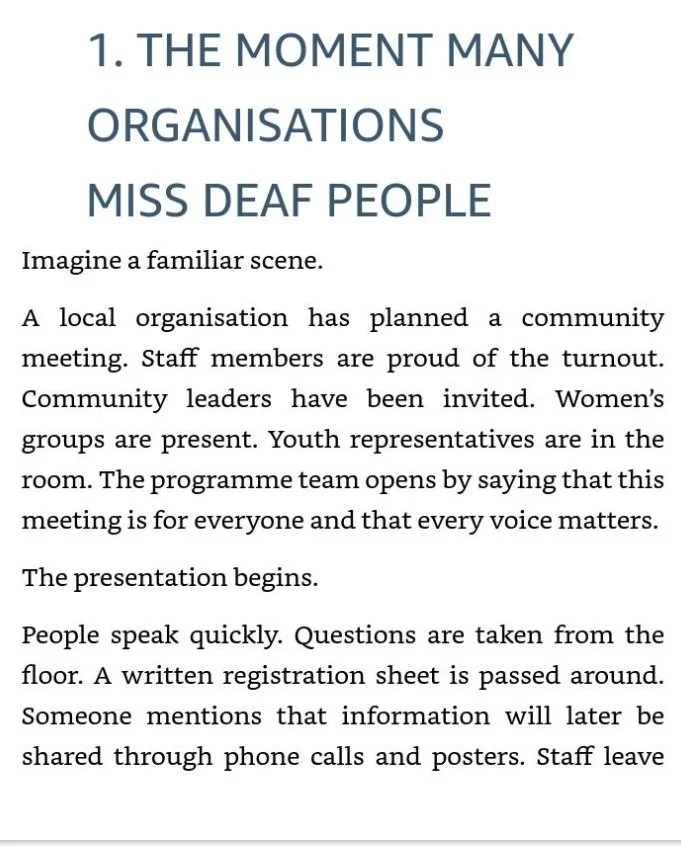
A text from the Field Guide on how organizations miss Deaf people
In clear, practical language, it helps you:
Understand Deaf communities in African settings as communities, with their own associations, histories, and institutions.
See the difference between charity, medical, rights‑based, and cultural‑linguistic models—and why that difference changes your practice.
Recognise sign languages as full languages, and ask better questions about communication access in meetings, schools, and services.
Map the state, non‑state, and Deaf‑led actors that shape Deaf people’s daily lives and access to services.
Look honestly at your own organisation and ask, “Where are Deaf people missing in our work, and why?”
It was written for NGO staff, disability practitioners, programme managers, trainers, and anyone who wants a grounded starting point—not another abstract policy document.
The missing piece: tools you can actually print and use
Reading a field guide is one thing. Changing practice is another.
That is why there is now a dedicated Companion Tools Pack for the “Working with Deaf People as Rights‑Holders” Field Guide. It turns the core ideas of the guide into ready‑to‑use worksheets, checklists, and facilitation pages you can print and take into meetings, reviews, and workshops.
Cover image of Deaf People as Rights-Holders in blue with white lettering
👉 Chapter 1 Companion Tools Pack
The tools pack includes:
Spot the Model reflection sheet – to help staff identify when they are operating in charity, medical, rights‑based, or cultural‑linguistic modes.
Deaf inclusion vocabulary reset sheet – to move away from vague or paternalistic language and towards respectful rights‑based wording.
Stakeholder mapping worksheet and influence–interest grid – to identify the government, NGO, community, and Deaf‑led actors who really shape Deaf people’s access.
“Where are Deaf people missing?” organisational checklist – a candid scan of policies, data, participation, communication, feedback, safeguarding, and budgeting.
Communication and access planning prompt sheet – for planning meetings, outreach, and services that Deaf people can actually use.
Programme review and six‑month action planner – to help teams pick realistic, time‑bound changes instead of vague intentions.
Training facilitation page – so managers or trainers can run a 45–60 minute internal session without designing a workshop from scratch.
In other words, the field guide gives you the “why” and “what”; the tools pack gives you the “how”.
Who these resources are for
These two products work best for:
NGO staff and disability practitioners in African contexts who know that “inclusive” on paper is not always inclusive in practice.
Programme managers and inclusion focal points who need structured tools for reviews, strategy days, and training.
Trainers and consultants working on disability inclusion, Deaf rights, or human‑rights‑based approaches.
Educators and students looking for grounded, African‑focused material on Deaf inclusion.
You do not need to be a legal expert, interpreter, or long‑time Deaf advocate to use them. They are written in plain professional language for people who are ready to learn, reflect, and act.
Learn more and stay connected
If you would like additional articles, resources, and reflections on working respectfully with Deaf communities, visit:
🌍 Website:www.beautifuld.org and www.beautifuld.co.uk
For training, collaboration, or organisational support, you can reach out directly at:
📧 Email:info@beautifuld.org
And if you want a practical way to start today:
Get the field guide on Amazon:
→ Working with Deaf People as Rights‑HoldersAdd the companion tools pack so you have print‑ready worksheets for your team:
→ Companion Tools Pack
Start with one honest checklist, one stakeholder map, and one six‑month action plan. That is often enough to begin changing how your organisation works with Deaf people—not just how it talks about inclusion.